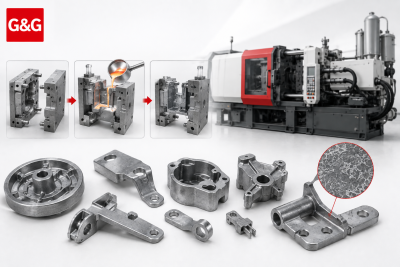
Zinc die casting is a high-precision manufacturing process used to produce metal components in medium to large production runs. In this process, a molten zinc alloy is injected under high pressure into a specially manufactured steel mold. The material solidifies within seconds, allowing the finished component to be removed. The process enables the cost-effective production of parts featuring complex geometries, tight tolerances, and high-quality surface finishes.
For many years, G&G Beschläge GmbH has utilized zinc die casting to manufacture high-quality furniture fittings and technical functional parts. Thanks to modern production facilities, in-house tooling expertise, and digitally monitored processes, the resulting components meet the highest standards of precision, quality, and cost-efficiency. Zinc die casting is therefore the ideal solution when the requirement is for durable, dimensionally accurate, and aesthetically appealing products.
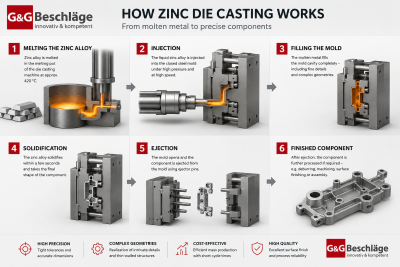
In zinc die casting, a zinc alloy is kept at processing temperature in a hot-chamber die casting machine and then injected under high pressure into a precisely manufactured steel mold. The molten alloy fills even the finest contours and solidifies within seconds. After the mold opens, the component is automatically removed and, depending on the requirements, deburred, mechanically machined, surface finished, or assembled.
At G&G Beschläge GmbH, the entire manufacturing process is digitally monitored and continuously documented. Modern machines, automated processes, and experienced employees ensure that every component is produced reproducibly with consistently high quality. This enables us to manufacture cost-efficient precision components for demanding applications in the furniture industry and industrial applications.
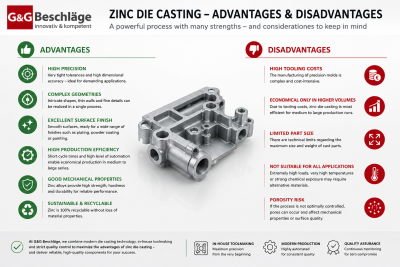
Zinc die casting is one of the most efficient manufacturing processes for the series production of high-quality metal components. Key advantages include high dimensional accuracy, excellent surface quality, and the ability to produce complex component geometries in a single manufacturing step. This helps reduce assembly effort and the need for post-processing. Furthermore, zinc is ideally suited for electroplating, powder coating, and painting, and stands out due to its high recyclability.
Like any manufacturing process, zinc die casting has its limitations. Producing a die-casting mold requires an initial investment, making the process particularly suitable for medium- to large-scale production runs. Maximum component size is also constrained by design factors. Drawing on years of experience, G&G Beschläge GmbH assists customers as early as the development phase in identifying the most cost-effective and technically sound solution.
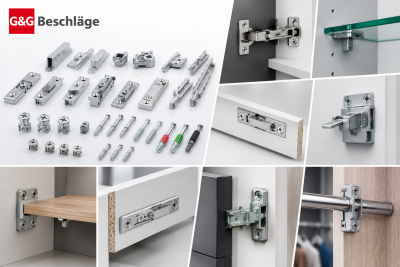
Zinc die-casting is used wherever precise, durable, and visually appealing metal components are required. For G&G Beschläge GmbH, however, zinc die-casting is not merely another manufacturing process—zinc die-casting, and specifically the production of hardware fittings, represents our core business and our particular strength.
G&G Beschläge specializes in the development and manufacture of zinc die-cast parts for the furniture and architectural hardware industries. We possess extensive experience in handling complex geometries, high production volumes, demanding surface finishes, and functionally critical components.
A key focus area is the furniture hardware industry. Our product range includes furniture fittings, connecting hardware, furniture handles, shelf supports, and cabinet hangers made from zinc die-cast. Our experience allows us to factor in requirements regarding function, dimensional accuracy, assembly, and surface finish right from the design stage.
Another major focus is the architectural hardware industry. This includes the window manufacturing sector, where we produce components for tilt-and-turn mechanisms and other window hardware. Zinc die-casting is particularly well-suited here for precise, complex components that must function reliably and be manufactured consistently in large volumes.
In addition, G&G manufactures custom zinc die-cast parts tailored to specific customer needs. We support our clients throughout the entire project lifecycle—from the initial concept, design, and feasibility assessment to mold making, sampling, and serial production.
Beyond our core sectors, zinc die-casting is utilized in various other industries, such as electrical engineering, mechanical engineering, the automotive sector, and the fields of locking systems, security technology, and sanitary fittings.
However, our core expertise lies firmly in zinc die-casting and hardware fittings. Our specialization provides us with comprehensive know-how across design, mold engineering, zinc die-casting production, post-processing, and surface finishing. G&G Fittings – Your specialist for zinc die-casting, furniture fittings, and architectural hardware.
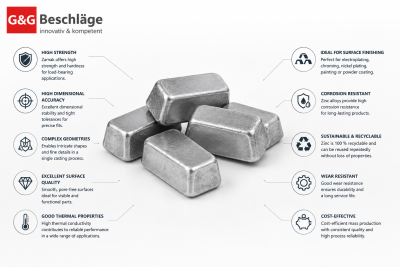
Zamak is a zinc alloy specifically developed for zinc die casting, offering excellent casting properties and high dimensional accuracy. The material enables the production of fine and intricate geometries, provides high strength, and at the same time offers excellent surface quality. This makes Zamak highly suitable for visible design components as well as technically demanding functional parts.
At G&G Beschläge GmbH, we primarily use the zinc alloys Z410 and Z430. Depending on the requirements of the individual component, we select the appropriate material. Factors such as strength, load requirements, function, dimensional accuracy, and surface finishing requirements are taken into account.
For G&G Beschläge GmbH, Zamak is therefore an ideal basis for durable and precisely manufactured products. In addition, zinc is almost completely recyclable and can be returned to the material cycle. The combination of precision, strength, design freedom, and sustainability makes Zamak an important material in modern die casting technology.
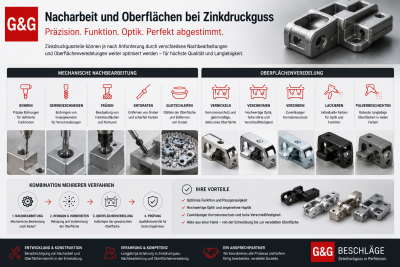
Zinc die castings offer good dimensional accuracy and a high-quality metallic surface finish immediately after casting. However, depending on the component's function, application, and aesthetic requirements, they can be further optimized through various post-processing and surface finishing techniques.
Mechanical post-processing allows features such as holes, threads, or specific functional surfaces to be machined after casting. This includes operations such as drilling, milling, threading, and deburring. Mass finishing processes, such as barrel or vibratory finishing, can also be used to remove burrs and achieve a uniform surface finish.
Surface finishing is a particularly important aspect of zinc die-cast parts. Thanks to its excellent surface properties, zinc is ideally suited for a wide range of coating processes. Depending on the requirements, options include electroplating, such as nickel, chrome, or zinc plating, as well as painting and powder coating. These processes can meet both decorative and functional requirements, allowing properties such as appearance, wear resistance, and corrosion resistance to be specifically tailored.
Combinations of different post-processing and finishing processes are also possible. For example, a component can first undergo mechanical machining, followed by cleaning and surface preparation, before receiving its final surface finish.
At G&G Beschläge GmbH, post-processing and surface finishing are taken into account from the early stages of component development and design. This allows us to assess which processes are technically suitable and economically viable at an early stage. For furniture fittings, factors such as tactile feel, appearance, corrosion protection, and wear resistance are just as important as functionality.
G&G coordinates the required machining and surface treatment processes, enabling us to supply customers with fully finished zinc die-cast parts. This provides customers with a seamless, end-to-end solution – from initial development and zinc die casting through to the final surface finish.