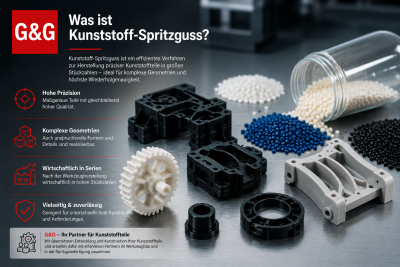
Plastic injection molding is one of the most important manufacturing processes for the cost-effective production of plastic components in medium to high volumes. The process is particularly well-suited for components that require consistent quality and high repeatability.
In plastic injection molding, plastic granules are first heated and melted. The molten plastic is then injected into an injection mold under high pressure. Inside the mold, the plastic takes on the shape of the cavity, cools down, and is subsequently ejected as a finished component.
A major advantage of the injection molding process is the ability to incorporate complex geometries, undercuts, ribs, mounting elements, and varying wall thicknesses into a single component. Once the mold has been manufactured, parts can be produced in large quantities with consistent quality and short cycle times.
The choice of plastic depends on the component's specific requirements. Depending on the application, engineering plastics may be used, offering specific properties such as strength, temperature resistance, wear resistance, chemical resistance, or superior surface quality.
G&G Beschläge GmbH utilizes plastic injection molding to complement its core business of zinc die-casting and furniture fittings. The process is particularly attractive when the production of specific components from plastic makes sense due to factors such as function, weight, geometry, or specific performance requirements.
G&G handles the development and technical design of the plastic components. We carry out the actual mold making and injection molding production in collaboration with specialized partner companies with whom we have long-standing relationships. This enables us to offer our customers comprehensive support for plastic components—spanning everything from the initial idea and design to mold creation and serial production.
Plastic injection molding is one of the most important manufacturing processes for the cost-effective production of plastic components in medium to high volumes. The process is particularly well-suited for components that require consistent quality and high repeatability.
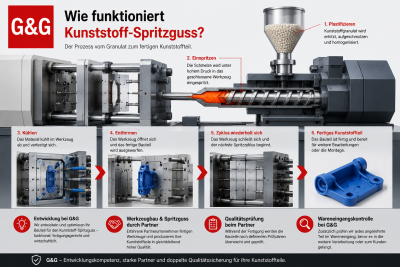
In plastic injection molding, plastic granules are first heated and melted. The molten plastic is then injected into an injection mold under high pressure. Inside the mold, the plastic takes on the shape of the cavity, cools down, and is subsequently ejected as a finished component.
A major advantage of the injection molding process is the ability to incorporate complex geometries, undercuts, ribs, mounting elements, and varying wall thicknesses into a single component. Once the mold has been manufactured, parts can be produced in large quantities with consistent quality and short cycle times.
The choice of plastic depends on the component's specific requirements. Depending on the application, engineering plastics may be used, offering specific properties such as strength, temperature resistance, wear resistance, chemical resistance, or superior surface quality.
G&G Beschläge GmbH utilizes plastic injection molding to complement its core business of zinc die-casting and furniture fittings. The process is particularly attractive when the production of specific components from plastic makes sense due to factors such as function, weight, geometry, or specific performance requirements.
G&G handles the development and technical design of the plastic components. We carry out the actual mold making and injection molding production in collaboration with specialized partner companies with whom we have long-standing relationships. This enables us to offer our customers comprehensive support for plastic components—spanning everything from the initial idea and design to mold creation and serial production.
Plastic injection molding is suitable for a wide range of components—from small, intricate plastic parts to larger functional components. The process is particularly cost-effective for serial production and high volumes, as it enables short cycle times and high repeatability once the injection mold has been manufactured.
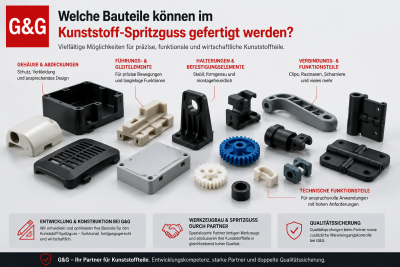
Injection molding also allows for the realization of complex geometries. Examples include housings, covers, guide elements, brackets, spacers, connectors, technical functional parts, and plastic components for furniture fittings. Depending on the design, features such as ribs, holes, clips, snap-fit connections, and other functional elements can be integrated directly into the component.
For the furniture industry, plastic injection molding offers opportunities for components where low weight, high production volumes, specific functionality, or particular surface finishes are required. Combinations of plastic parts and zinc die-cast parts can also be a practical solution.
At G&G Beschläge, the focus extends beyond the mere production of a plastic part. Right from the start of a project, our design and development teams assess whether the desired component is suitable for plastic injection molding and how it can be optimized for manufacturing. Factors such as geometry, wall thickness, demoldability, material selection, and projected production volumes are taken into account.
Specialized partner companies handle mold making and the actual injection molding production. G&G coordinates the technical implementation and manages the project from the development stage through to serial delivery. Quality is monitored both at the injection molding partner's facility and through our own incoming goods inspection.
This enables us to offer our customers plastic injection-molded parts—particularly for applications requiring precise, repeatable, and cost-effective plastic components for serial production.
A wide variety of thermoplastics can be processed using plastic injection molding. The type of plastic suitable for a specific component depends primarily on requirements regarding strength, temperature resistance, wear resistance, chemical resistance, surface quality, and cost.
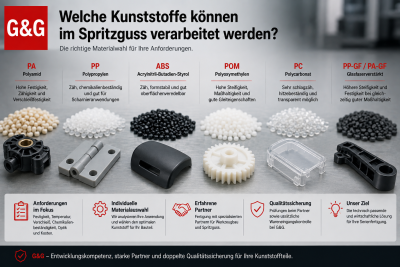
Commonly used plastics in injection molding include polyamide (PA), polypropylene (PP), polyethylene (PE), acrylonitrile butadiene styrene (ABS), polyoxymethylene (POM), and polycarbonate (PC). Depending on the application, these plastics can also be modified with glass fibers or other reinforcements to enhance specific mechanical or thermal properties.
For furniture fittings and technical plastic parts, materials offering a favorable combination of strength, dimensional stability, wear resistance, and cost-effective manufacturing are often ideal. Friction and wear also play a crucial role in the case of moving parts or components subject to mechanical stress.
At G&G Beschläge, material selection is taken into account right from the development stage. We work with our customers to determine the requirements the plastic component must meet and identify the most suitable material. In doing so, we consider factors such as the component's function, mechanical load, ambient temperature, contact with other materials, and planned production volumes.
The actual plastic injection molding production is carried out by our specialized partner companies. G&G handles the development and technical coordination of the component and manages implementation with the mold maker and the injection molding partner. The materials used and their specifications are selected in accordance with the agreed requirements.
Consequently, it is impossible to make a blanket statement about which plastic is "the best." The right plastic material is always selected based on the specific application and the component's requirements. This is precisely where G&G supports its customers during the development phase—aiming to find a technically suitable and cost-effective solution for series production.
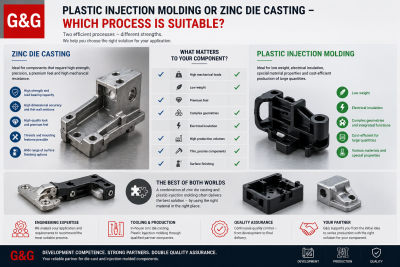
Whether a component should be manufactured using plastic injection molding or zinc die casting depends on the requirements of the component, its function, material properties and the planned production volume. Both processes are suitable for efficient series production, but they differ significantly in terms of material properties, weight, strength and possible applications.
Zinc die casting is particularly suitable for components requiring high strength, good dimensional accuracy, a high-quality feel or high mechanical resistance. Zinc can be cast with high precision and allows complex geometries with relatively thin walls. Depending on the design, threads, mounting features and other functions can be integrated directly into the die-cast part or added through subsequent machining. For furniture fittings, connecting elements and technical components, zinc die casting is therefore often an excellent solution.
Plastic injection molding, on the other hand, offers advantages when low component weight, electrical insulation, specific chemical properties or cost-effective production of large quantities are important. Depending on the plastic material, complex geometries, clips, snap connections, guides and other functional elements can also be integrated directly into the component.
| Requirement | Zinc Die Casting | Plastic Injection Molding |
|---|---|---|
| High mechanical loads | Very suitable | Depending on material |
| Low weight | Less suitable | Very suitable |
| High-quality feel | Very suitable | Depending on material |
| Complex geometries | Very suitable | Very suitable |
| Electrical insulation | Not suitable | Very suitable |
| High production volumes | Very suitable | Very suitable |
| Thin, precise components | Very suitable | Good to very good |
| Surface finishing | Wide range of options | Depending on material |
At G&G Beschläge GmbH, we therefore look at more than just the material. Our development team evaluates the entire application, including geometry, mechanical loads, wall thicknesses, function, production volume, material requirements and desired surface finish. Based on these factors, we determine together with the customer which manufacturing process is technically and economically most suitable.
A combination of zinc die casting and plastic injection molding can also be the optimal solution. Especially for furniture fittings and technical assemblies, the different properties of both materials can be used strategically within one product.
G&G has many years of experience in the development and production of zinc die-cast components and complements this expertise with the development of plastic injection-molded components. While zinc die casting is produced in-house, tooling and plastic injection molding are carried out by specialized partner companies. This allows us to support our customers already during the development phase and identify the most suitable solution for each application.
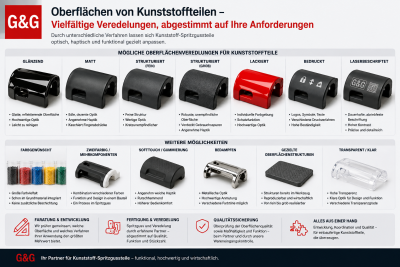
Depending on component geometry, material, and specifications, plastic injection-molded parts can emerge from the mold largely in their finished state. Many features—such as holes, snap-fits, clips, guides, or mounting elements—can be integrated directly into the plastic component, thereby reducing the need for additional processing steps.
If further processing is required, various methods are available for plastic injection-molded parts. These include, for example, drilling, milling, deburring, threading, and the creation of holes or cutouts. Depending on the component, additional elements such as threaded inserts can also be installed or mounted.
Furthermore, plastic parts can be modified visually or functionally through various surface finishing techniques, such as painting, printing, vapor deposition, or marking. Distinct surface textures can also be created directly via the injection mold itself.
At G&G Beschläge, we evaluate which functions can be implemented directly during the injection molding process and which post-processing steps are appropriate as early as the development and design phase. In doing so, we take into account factors such as geometry, the plastic material used, the required surface finish, and planned production volumes.
Plastic injection molding and any necessary post-processing are carried out by our specialized partner companies. G&G coordinates the implementation and ensures compliance with agreed requirements through quality checks at the partner's facility and incoming goods inspections at G&G.
This allows us to offer our customers plastic injection-molded parts not merely as basic molded items but—depending on requirements—as processed, finished, and ready-to-assemble plastic components.