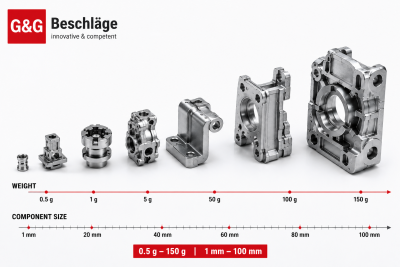
The component sizes achievable through zinc die casting depend on various factors, including geometry, wall thickness, weight, and requirements regarding stability and functionality. Thanks to the excellent flow characteristics of zinc, it is possible to cost-effectively manufacture everything from very small precision parts to larger functional components.
G&G Beschläge GmbH manufactures a wide range of zinc die-cast components – from intricate connecting elements and cam locks to larger furniture fittings and technical functional parts. Our production range covers components from approximately 1 to 100 mm and a part weight of around 0.5 to 150 g, depending on the geometry and design.
As early as the development phase, our design engineers assess which component dimensions are best suited for cost-effective and process-reliable production. Together with our customers, we develop solutions that optimally combine functionality, design, manufacturability, and cost-efficiency.
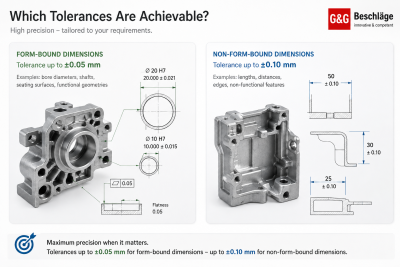
Zinc die casting is one of the most precise casting processes, enabling tight manufacturing tolerances and high repeatability. The tolerances actually achievable depend on the component geometry, dimensions, and specific functional requirements.
For suitable form-bound dimensions, G&G Beschläge can achieve tolerances of up to ±0.05 mm. For non-form-bound dimensions, achievable tolerances are typically up to ±0.10 mm. The actual tolerances are always assessed based on the individual component and drawing requirements.
Thanks to modern die-casting machines, precision die-casting tools, and digitally monitored production, G&G Beschläge GmbH achieves consistently high dimensional accuracy throughout the entire production run. We take the required tolerances into account during the design phase and advise our customers on manufacturing-optimized component designs.
If particularly tight dimensional specifications are required, individual functional surfaces can be further optimized through targeted post-processing. This allows demanding requirements for precision and dimensional fit to be reliably achieved.
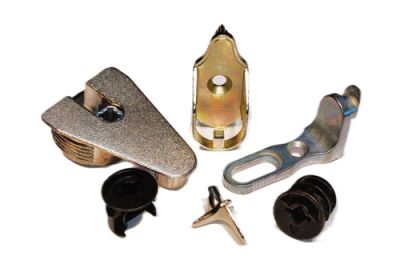
As a specialist manufacturer of furniture fittings and zinc die-cast components, we know that a technical component is only truly complete once it has received the right surface finish. The choice of surface treatment depends on the requirements for appearance, tactile quality, corrosion protection, wear resistance, and application.
Drawing on our extensive experience in international sourcing and cooperation with specialized surface finishing partners, we offer a wide range of finishes for zinc die-cast components, furniture fittings, and technical components. These include electroplating, nickel plating, chrome plating, zinc plating, painting, and powder coating.
Our global sourcing and supply chain planning provides access to qualified partners and complementary components. Even for large project volumes, we focus on consistent surface quality, precision, and cost-efficiency. Depending on the requirements, semi-automated and fully automated processes can be used.
G&G Beschläge GmbH coordinates the required surface treatment and finishing processes and takes these requirements into account from the early stages of component development and design. This allows technical requirements and aesthetic expectations to be considered from the outset.
Further information about our services, surface finishes, and finishing options can be found in the “Services” section.
Yes—though it depends on the type of thread.
External threads can be produced directly within the die-casting mold for zinc components. They are formed during the casting process itself and generally require no additional machining.
Due to design constraints, this is not possible for enclosed internal threads. Since the thread is completely surrounded by material, it cannot be released directly from the mold. Such threads are created in a separate machining step following the die-casting process.
To handle this, G&G Beschläge GmbH utilizes an automated, robot-assisted threading system that cuts internal threads with precision, repeatability, and cost-efficiency during series production. This enables the manufacture of large volumes while maintaining consistently high quality.
An exception applies to open-sided internal threads based on an open contour or a so-called "half-shell" design. These can be formed directly within the die-casting mold, as they can be released without difficulty.
During the component development phase, G&G Beschläge GmbH’s design engineers assess which threads can be cast directly and where post-processing is appropriate. The goal is to achieve a solution for every component that is both technically optimal and cost-effective.