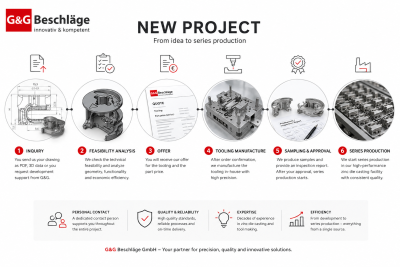
A successful project begins with sound planning. At G&G Beschläge GmbH, new projects start either with a customer-supplied drawing or 3D design, or as a joint development project right from the design phase.
Upon receipt of the data, our design engineers first assess the technical feasibility of the component. This involves evaluating factors such as geometry, wall thickness, demoldability, and future cost-efficiency. Based on this analysis, we prepare a quotation covering both the die-casting mold and the unit price for the parts.
Once the order is placed, mold construction begins. Subsequently, initial samples are produced and documented in an inspection report. Series production commences following customer approval. A dedicated contact person supports you throughout the entire project—from the initial concept to full-scale production.
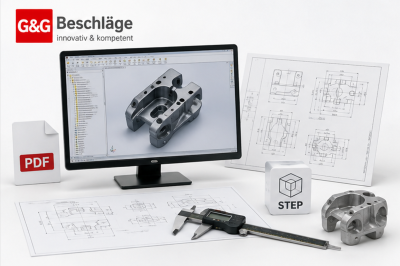
The more complete the technical data is, the faster and more precisely we can evaluate your project and prepare a quotation for zinc die casting.
To prepare a quotation, we ideally require:
- Technical drawings in PDF format
- 3D data in a standard exchange format, e.g. STEP
- Information on part weight or desired dimensions
- Planned annual or total production volumes
- Details regarding the desired surface finish and post-processing, if already known
Based on this information, our design engineers and technical specialists can assess the technical feasibility, required tooling, and expected production costs. This enables us to calculate both the tooling cost and a realistic unit price for series production.
If finished drawings or 3D data are not yet available, G&G Beschläge GmbH is happy to support you during the development phase. Together with our customers, we develop a cost-effective and manufacturing-optimized solution for the required component.
The earlier we are involved in a project, the better we can consider aspects such as geometry, wall thickness, demoldability, tolerances, and surface finishing during the design process. This can help optimize tooling costs, post-processing, and unit costs.
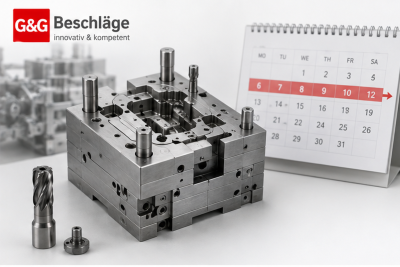
The duration of a project depends on the complexity of the component and the scope of the tooling.
Typically, around six weeks elapse between the placement of the order and the initial sample submission. During this period, the die-casting tool, the initial sample parts, and the corresponding inspection report are produced.
For particularly urgent projects, we can offer shorter lead times upon prior agreement. Short decision-making paths and close coordination with our customers allow many projects to be significantly accelerated.
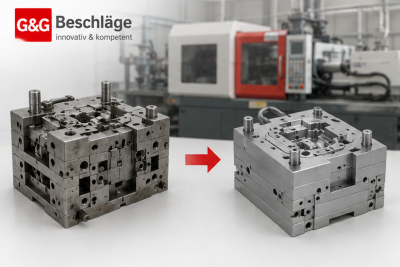
Yes. In principle, G&G Beschläge GmbH also accepts existing die-casting molds from other manufacturers.
Before taking over a mold, we first verify that it is technically compatible with our die-casting machines and that cost-effective series production is feasible. This assessment includes factors such as the condition of the mold, dimensions, tooling technology, and expected service life.
In many cases, existing die-casting molds can be transferred and used without major issues. However, depending on the age, condition, and previous production history of the mold, manufacturing a new casting mold may prove to be the more technically and economically efficient solution. Compatibility with our production equipment is also an important factor.
G&G Beschläge assesses each existing tooling solution individually and advises customers whether taking over the existing mold or investing in a new die-casting mold is the better option for the planned series production.
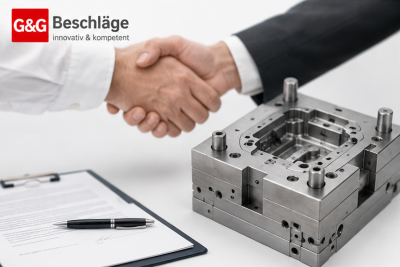
In principle, the die-casting tool commissioned and paid for by the customer remains the customer’s property.
G&G Beschläge GmbH handles the proper storage, maintenance, and use of the die-casting tool during production. This helps ensure consistently high quality, process reliability, and a long tool service life.
An exception applies to tools that are fully financed by G&G Beschläge GmbH itself or used for standard products that are available to multiple customers. In these cases, ownership of the tool remains with G&G Beschläge GmbH.
For customer-specific projects, the ownership of the die-casting tool is defined according to the individual agreement with the customer.